Auto-Labeled Weed Detection and Species Classification
A lawn-care perception component that distills foundation-model masks and classifications into a compact weed detector.
- My contribution
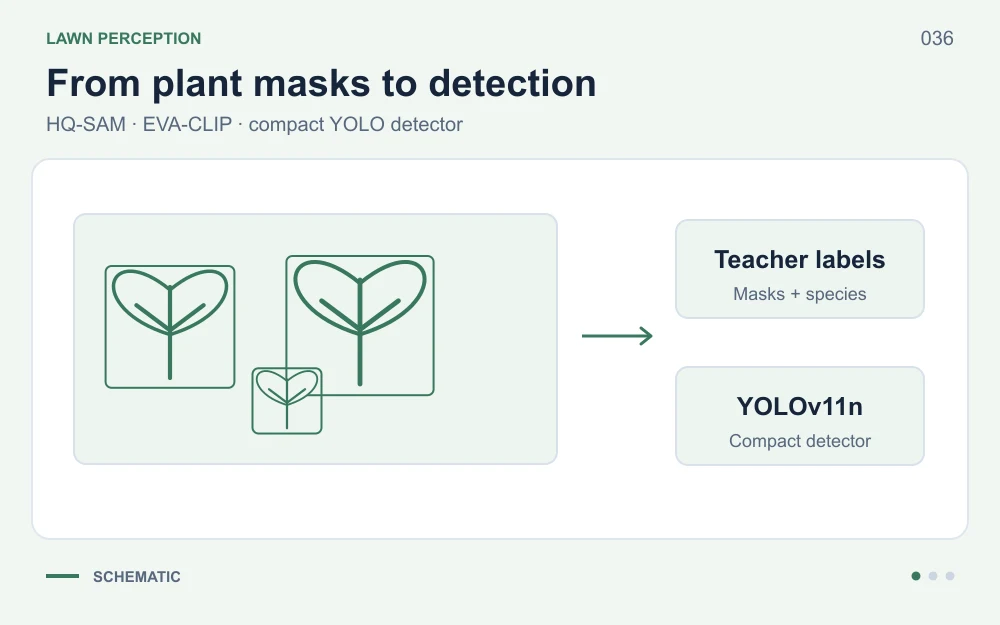
- HQ-SAM and EVA-CLIP annotation pipeline and compact YOLOv11n training.
- Outcome
- Foundation-model labels distilled into a compact weed detector.
Project overview
| Area | Details |
|---|---|
| Product context | Perception for an autonomous lawn-care robot |
| Teacher pipeline | HQ-SAM mask generation and EVA-CLIP classification |
| Deployment model | Compact YOLOv11n detector |
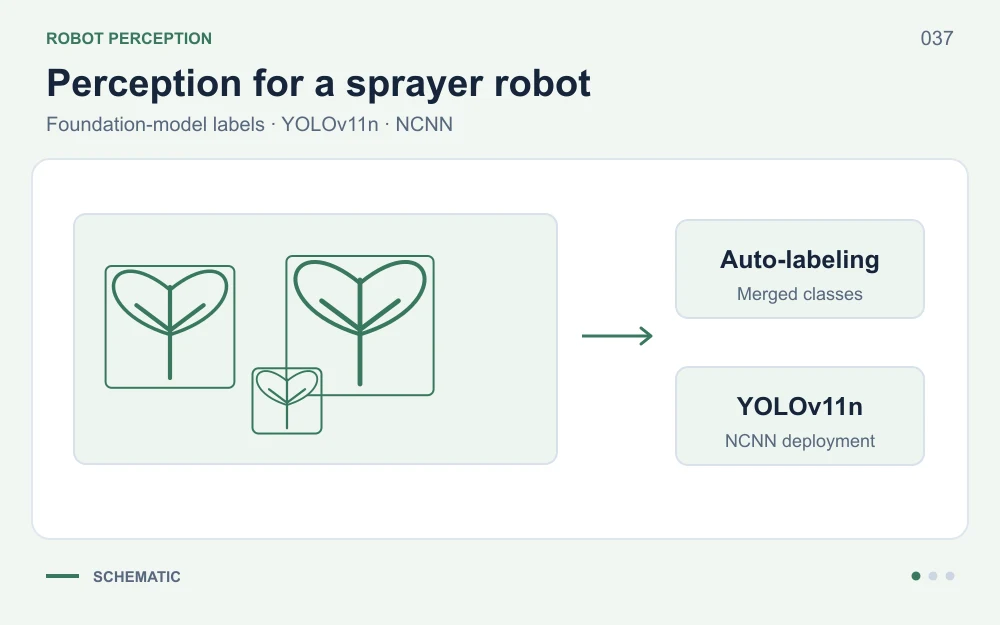
I built an automated labeling pipeline to turn unlabeled lawn imagery into training data for a smaller deployment model. Large foundation models acted as offline teachers; the resulting annotations were then used to train a compact detector suited to the robot’s runtime constraints.
Model Roles
| Component | Role |
|---|---|
| YOLOv11n | Small deployable weed detector |
| HQ-SAM | High-quality mask generation and refinement |
| EVA-CLIP | Region and weed-species classification |
Label-generation pipeline
- Generate candidate masks with HQ-SAM.
- Filter noisy masks with contour detection and minimum area thresholds.
- Merge small related masks, apply
5x5dilation, and recover cleaner bounding boxes. - Classify each candidate region with EVA-CLIP text prompts such as weed, grass, and soil.
- Refine selected masks using bounding-box prompts to HQ-SAM.
- Export image-wise weed bounding boxes into a dataset-level JSON annotation file.
Species-classification path
- Crop detected weed regions from the image.
- Classify crops with
QuanSun/EVA-CLIP-E_psz14_plus_s9B. - Evaluated a larger EVA-CLIP model in place of the initial CLIP backbone for stronger region classification.
Design rationale
Using the heavier models offline separates annotation quality from deployment cost. The edge model receives task-specific training labels without carrying the teachers’ compute footprint onto the robot. A future iteration would fine-tune the mask-generation stage once enough reviewed examples are available.
Demonstration
The embedded demonstration shows this perception work in the context of the wider autonomous lawn-care robot.
Evidence & demonstration
Demos & project media
Project demonstration
Loads content from LinkedIn when you choose to play.