Instance Segmentation from Auto-Labeling to Edge Deployment
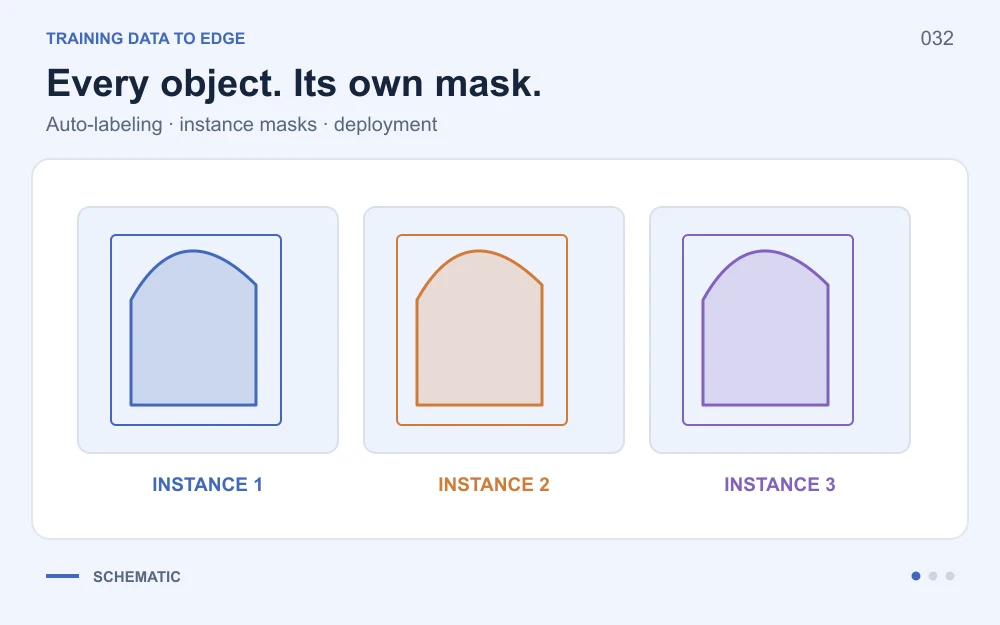
An end-to-end instance-segmentation workflow spanning foundation-model auto-labeling, training, evaluation, and edge deployment.
- My contribution
- Foundation-model labeling, YOLOv11 training, evaluation, and quantized deployment.
- Outcome
- A repeatable pipeline from unlabeled images to edge instance segmentation.
Project overview
| Area | Details |
|---|---|
| Goal | Convert unlabeled images into an edge-deployable instance-segmentation model |
| Teacher models | SEEM and SAMv2 |
| Deployment model | YOLOv11 with post-training quantization |
I developed the full path from foundation-model-assisted annotation to a smaller deployable model. The workflow separates expensive offline label generation from efficient runtime inference, while retaining class-aware masks throughout the conversion.
Auto-labeling pipeline
- Used SEEM to generate rough masks with class labels.
- Converted rough masks into bounding-box prompts.
- Used SAMv2 to generate cleaner segmentation masks from those prompts.
- Modified SAMv2 output with an additional classifier to attach class labels to predicted masks.
Training and deployment
- Trained a deployable YOLOv11 model using the generated labels.
- Applied post-training quantization for faster edge-device inference.
Engineering value
The pipeline makes dataset expansion repeatable: new imagery can pass through the same teacher-model stages, be reviewed, and feed the next deployment-model iteration. This creates a practical bridge between general-purpose foundation models and product-specific edge inference.
Evidence & demonstration
Demos & project media
Project demonstration
Loads content from LinkedIn when you choose to play.